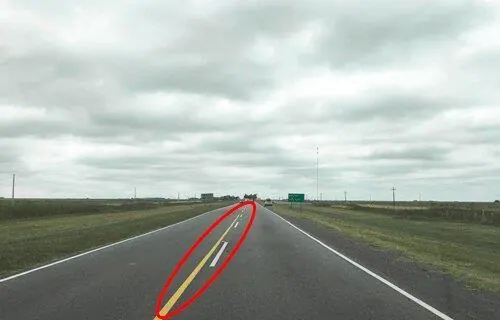
Faced with the central demarcation of the road indicated, what is the conduct to be followed?
Question and answers
Faced with the central demarcation of the road indicated, what is the conduct to be followed?
- It must respect the rules with regard to the nearest line; if it is continuous, it should not pass through and if it is discontinued, it should be permitted to do so. ✓ correct
- It must respect the rules with regard to the nearest line; if it is non-continuous, it should not be crossed and if it is continuous, it should be permitted to do so.
- None of them should be transferred.
As in the exam (Spanish)
Frente a la demarcación central de la calzada señalada, ¿cuál es la conducta a seguir?
- Se debe respetar lo que rige con respecto a la línea más próxima; si es continua no traspasarla y si es discontinua está permitido hacerlo. ✓
- Se debe respetar lo que rige con respecto a la línea más próxima; si es discontinua no traspasarla y si es continua está permitido hacerlo.
- No debe traspasarse ninguna de ellas.
Correct answer: “It must respect the rules with regard to the nearest line; if it is continuous, it should not pass through and if it is discontinued, it should be permitted to do so.” (in the exam: “Se debe respetar lo que rige con respecto a la línea más próxima; si es continua no traspasarla y si es discontinua está permitido hacerlo.”).
The question is part of the official Buenos Aires City theory test for classes B and A, topic “Road signs and markings”. It will be in Spanish, so learn the original wording too.
Practise this topic 40-question mock exam
More questions on “Road signs and markings”
- What does this yellow demarcation indicate on the road?
- Road sign “People working” in Argentina
- What does this signal indicate?
- Road sign “Strong winds on the side” in Argentina
- Road sign “Horsemen's cross” in Argentina
- Road sign “I'm on a winding path” in Argentina
- Road sign “Approach to a drawbridge, rotary bridge or floating bridge” in Argentina
- Road sign “Crossing (forkling)” in Argentina
Questions and answers come from the City of Buenos Aires official “Preguntas de examen” collections (classes A and B, based on the Manual del Conductor). Translation by LifeArg; only the Spanish text counts in the exam.