The vehicle and maintenance: Argentina driving test questions
25 official Buenos Aires exam questions on “The vehicle and maintenance” with correct answers, the Spanish original and an English translation. A short rules summary and topic practice.
The rules in brief
Before a trip check tyres (pressure and tread), brakes, lights, wipers and fluid levels. Load the car so nothing blocks the view, lights or plate; heavy items low and near the centre.
Required kit: a fire extinguisher, two warning triangles (balizas portátiles) and a reflective vest.
All questions with answers (25)
-
Mechanical faults are usually due to negligent behaviour on the part of vehicle owners, who do not check the condition of their carPor lo general, las fallas mecánicas se deben a conductas negligentes por parte de los propietarios de los vehículos, que no se ocupan de la verificación del estado de su automóvil
✅ True. · class BA
-
When you suffer the loss of a vehicle's domain plate, where can you request replacement?Al sufrir la pérdida de la placa de dominio de un vehículo, ¿dónde se puede solicitar su reposición?
✅ It must be requested in the National Registry of Vehicle Property that corresponds to the vehicle. · class BA
-
What is the average reaction time of a driver from when he perceives a danger until he drives the brake?¿Cuál es el tiempo promedio de reacción de un conductor desde que percibe un peligro hasta que acciona el freno?
✅ Approximately 1 second. · class BA
-
Transitional signals indicate the execution of construction and maintenance work on or near the track:Las señales transitorias señalizan la ejecución de trabajos de construcción y mantenimiento en la vía, o en zonas próximas a las mismas:
✅ True. · class BA
-
If the vehicle is inadvertently exiting the road when driving by route, it is recommended:Si al circular por ruta, el vehículo sale involuntariamente de la calzada, es recomendable:
✅ Slow down (not brake). · class B
-
What is called “aquaplanning”?¿A qué se denomina “aquaplaning”?
✅ At the loss of adhesion of the tyre to the floor because of the layer of water accumulated on the pavement, which is greater than the amount that can be ejected through the drawings of the tires. · class BA
-
If the road is wet and there are puddles, can the brakes lose efficiency?Si la calzada está mojada y hay charcos, ¿pueden perder eficacia los frenos?
✅ Yes, because wetting may not work effectively. · class BA
-
What is called preventive conduction?¿A qué se denomina conducción preventiva?
✅ To adopt cautious conduct when driving, which consider responsibility for the acts carried out and to anticipate the conduct of others. · class BA
-
Of the factors cited, which is involved in excess fuel consumption?De los factores citados, ¿cuál interviene en el exceso de consumo de combustible?
✅ Both answers, A and B, are correct. · class BA
-
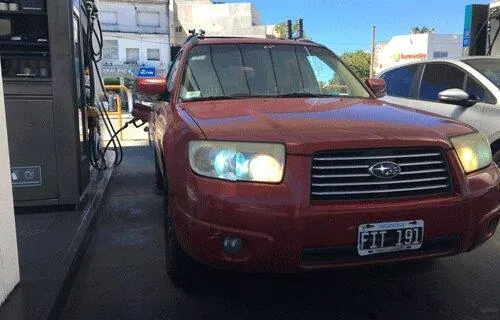 According to Law 2148, is this vehicle loading fuel correctly?Según la Ley 2148, ¿este vehículo está cargando combustible de manera correcta?
✅ No, since fuel must not be charged with lights and engine on by regulation. · class B
-
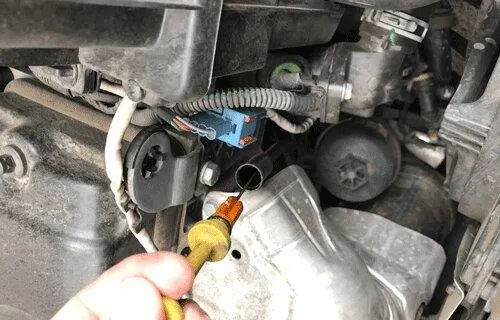 What's the use of this metal rod?¿Para qué sirve esta varilla metálica?
✅ To check the oil level. · class BA
-
It is important to perform proper vehicle maintenance because...Es importante realizar un correcto mantenimiento vehicular porque...
✅ Both answers, A and B, are correct. · class BA
-
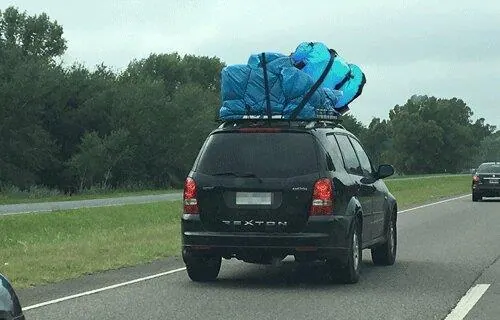 With regard to fuel consumption, what are the consequences of circulating as follows?Con respecto al consumo de combustible, ¿qué consecuencias trae circular de la siguiente forma?
✅ It increases wind resistance and thereby increases fuel consumption. · class B
-
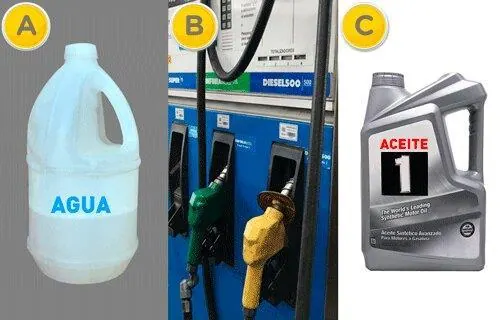 What is a motor lubricated with?¿Con qué se lubrica un motor?
✅ Option C. · class BA
-
What is called “blind point”?¿A qué se llama “Punto Ciego”?
✅ The area of view of the environment, to which the driver does not have access either directly or because the rearview mirrors do not reflect it. · class BA
-
To ensure safe driving, when is it advisable to check the orientation of rearview mirrors?Para realizar una conducción segura, ¿cuándo es recomendable verificar la orientación de los espejos retrovisores?
✅ Before you start the march. · class BA
-
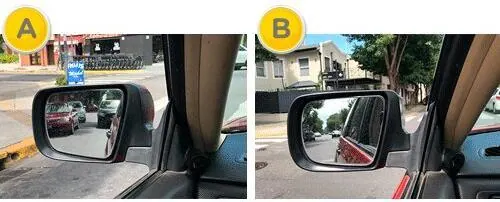 Indicate which of these images shows the correct way to place the rearview mirror:Indique cuál de estas imágenes muestra la manera correcta de colocar el espejo retrovisor:
✅ Image A. · class B
-
What is meant by the cabin?¿Qué se entiende por habitáculo?
✅ Space to be occupied by the driver and passengers. · class B
-
How should tyres be found to check the correct air pressure?¿Cómo deben encontrarse los neumáticos para comprobar la correcta presión de aire?
✅ Cold. · class BA
-
What is the correct pressure on the tires of a particular car?¿Cuál es la correcta presión de los neumáticos de un automóvil particular?
✅ The one that indicates the user manual of that car. · class B
-
Where in the vehicle is it convenient to put your luggage?¿En qué parte del vehículo es conveniente poner el equipaje?
✅ The heaviest at the bottom of the trunk, near the center of the car. That helps directional stability and curve behavior. · class B
-
Under Act No. 2148, is it mandatory to wear a vest of reflective material?Según la Ley N° 2148, ¿es obligatorio llevar un chaleco de material reflectivo?
✅ Yes, it is mandatory and must be carried inside the cabin in order to be able to use it if you need to descend into the driveway, in front of some cause of force majeure. · class B
-
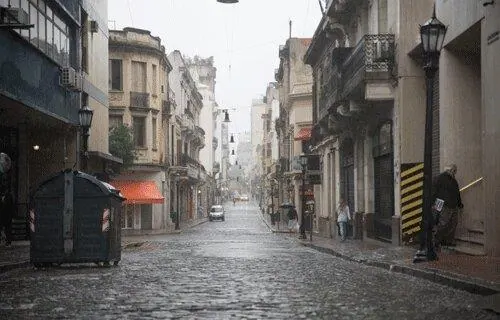 With this climate condition, the motor vehicle adheres better to the driveway if...Con esta condición climática, el motovehículo se adhiere mejor a la calzada si...
✅ The tyre retains the drawing throughout the surface. · class A
-
If driving a motor vehicle through a wet driveway with puddles and brakes get wet, losing their efficiency. What would it be convenient to do to dry them?Si al conducir un motovehículo por una calzada mojada con charcos y los frenos se mojan, perdiendo su eficacia. ¿Qué resultaría conveniente hacer para secarlos?
✅ Slow down gently and repeatedly, while maintaining acceleration. · class A
-
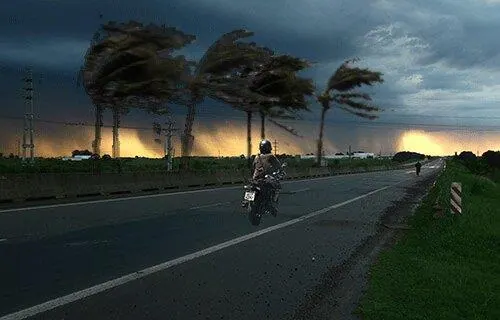 Under these climatic conditions, what should you do to safely circulate with a moped?Bajo estas condiciones climáticas ¿qué debe hacer para circular con seguridad con un ciclomotor?
✅ Hold the moped handle firmly and reduce speed. · class A
Other topics
- Road signs and markings72
- Right of way and intersections50
- Speed and following distance48
- Stopping and parking31
- Lanes, overtaking and manoeuvres35
- Alcohol, fatigue and phones37
- Seat belts, helmets and children19
- Lights and signals25
- Pedestrians, cyclists and scooters37
- Documents, insurance and fines36
- Crashes and emergencies32
- Motorcycles (class A)97
- Safe driving60
Questions and answers come from the City of Buenos Aires official “Preguntas de examen” collections (classes A and B, based on the Manual del Conductor). Translation by LifeArg; only the Spanish text counts in the exam.